The Winnemucca Institute for Advanced Studies presents
How Stars Operate, and, Do They Age with Time
[ with some attendant thoughts and postulations at the end of Part Two]
Part One
Abstract
Iron has a "Low Ionization Potential" (IP) and it is not radioactive, this makes it the best candidate for being the major constituent of a star's 'inner-core body', and when strongly ionized would make a star a strong positive Anode in the overall Galactic Electric Circuit, and any 'free roaming electrons' in the ISM ( InterStellar Medium ) would be strongly attracted to it, and when they 'impinge' on that star's surface, this is Where a star would get the 'energy input' that powers its EM Spectrum 'output'. No inner-core fusion-process needed. But it's a bit of a trick to get a star 'started', as the iron needs a 'kick' to get it ionized in the beginning, as well as 'accumulated', and a Z-Pinch in a Birkeland Current would be the ideal candidate for that 'beginning'.
In the large picture, our Galaxy is theorized to have an ISM 'drift' of electrons that are continually 'flowing past' our Sun's Heliopause boundary, we're not quite sure why this would be, but it strongly seems to be. The Voyager spacecraft confirmed this when it approached and then passed thru our Sun's Heliopause boundary layer, and on its somewhat lengthy approach detected 'magnetic bubbles' (in Mainstream's terminology). This Heliopause 'boundary' is where the Sun's 'sphere of influence' stops, and an Electric Double Layer (DL) is present at the boundary, a layer which completely surrounds the 'sphere' or 'bubble' that our Sun has determined is its' 'Electric Jurisdiction' in space. Our Sun's surrounding Electric Field is the 'dominant field' in this 'bubble' or 'Sphere of Influence' that extends from the Sun to about 14 Billion miles away at its Heliopause. And remember, it takes an electric current to produce a magnetic field, as there are no 'permanent magnets' in outer space, and, as plasma is not a solid, it is a gas; and thusly a moving plasma, like the so-called Solar Wind, could qualify as an 'electric current', and that may well be what Mainstream unknowingly would require for the . . ."data from the Voyagers that determined that the Heliosheath was not smooth, but filled with giant magnetic bubbles." [27] as, Due to the 'turbulence' in the Solar Wind at various distances from the Sun in the Heliosheath and before the Heliopause boundary layer.
Also, the TRACE "Sun-observing satellite", from 1998 to 2010 determined that the Sun has a "solid non-changing surface" just below its Photosphere !! ( or very, very slowly changing surface ), which totally disproves the "nuclear fusion 'cascade' giant-gas-ball hypothesis" of the Mainstream for the last 80 years as termed in their "Standard Solar Model", and as that 'solid surface' is emanating in the Fe9 and Fe10 wavelengths ( the 9th and 10th electron ionized state of Iron ), this more than strongly indicates that the nine and ten times Ionized Iron is what that 'solid surface' below the Sun's Photosphere is made of . . . and that is Iron !!! [2] [3]
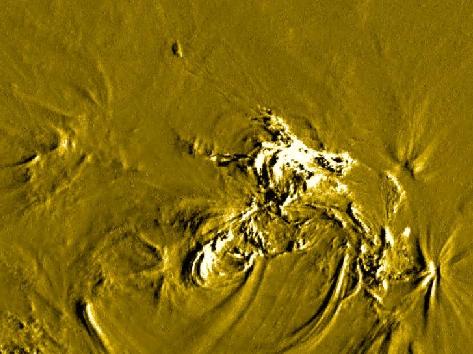
"The above photograph is one in a "running difference" series of images of the Sun's true solid surface as revealed by the TRACE satellite using its 171Å (Ångstrom) filter. This filter is specifically sensitive to Iron Ion emissions in the 9th and 10th Ionization States (Fe IX / X) and it recorded a C3.3 Flare and Mass Ejection in sunspot area AR 9143 in 171Å on 28 Aug. 2000. The Flare activity is caused by increased electrical activity as fast moving plasma sweeps over the solid Sun surface 'mountain ridges', resulting in increased electrical activity on the windward side of the 'mountain ranges'."
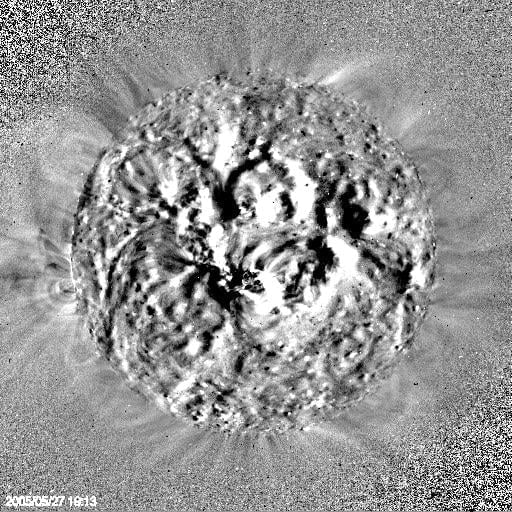
"This "Running Difference" image of the Sun's surface was captured by SOHO. This NASA image was taken on May 27th 2005 at 19:13 using the 195Å filter that is sensitive to Iron Ion emissions. These same complex visible surface structures are visible days and weeks later."
We definitely must take new images in these wavelengths ( 171Å and 195Å ) to verify if these 'major structures' are still there, and for exactly how long they remain, and exactly how fast they change, and what their 'rate of change' is, or is not.
This more than strongly suggests, yea it proves, our Sun, a Star, has a predominantly Iron 'body' surrounded by an 'atmosphere' of plasma in various states of ionization, and the arriving ISM electron energy is what supplies the energy for its EM Spectrum output, so as to shine. And our Sun, or any star, is NOT an inner core of Fusion Reactions going in a hierarchical cascade of subsequently larger atom building processes for its energy. Our Sun and Stars are mostly a "Zero Sum Game" function, that is mainly powered by the ISM's Electron Drift !!! There are however some 'friction losses' in this 'equation', in that deeper Neutrons may 'evaporate' and help supply the Solar Wind !! and so Stars may well be 'evaporating slowly' in addition to other ways that they might 'age' with time.
Argument
The Interstellar Medium (ISM) has 'energy' in it, in the form of 'electrons', and that energy is attracted to a star, as stars are a 'positive anode' in the 'circuit', and electrons are a 'negative cathode' in the circuit, and both are attracted to each other. This is How a star gets the energy it needs to 'shine' and Where it gets that energy from, the ISM.
"NASA announced that Voyager 1 had crossed the Heliopause on 25 August 2012 at about 15 Billion miles from the Sun, and Voyager 2 had crossed the Heliopause on 5 November 2018 at about 14 Billion miles from the Sun." [25]
There seems to be some disagreement on the size and shape of the Sun's Heliosphere. The Mainstream thinks our Sun's Heliosphere is a very 'elongated sphere', rather than a more 'round sphere' as I presume most others would assume, as how could the 'meager' drift of the ISM, about 50 meters per second, cause such an 'elongation' as this Mainstream diagram / illustration presupposes. [25]
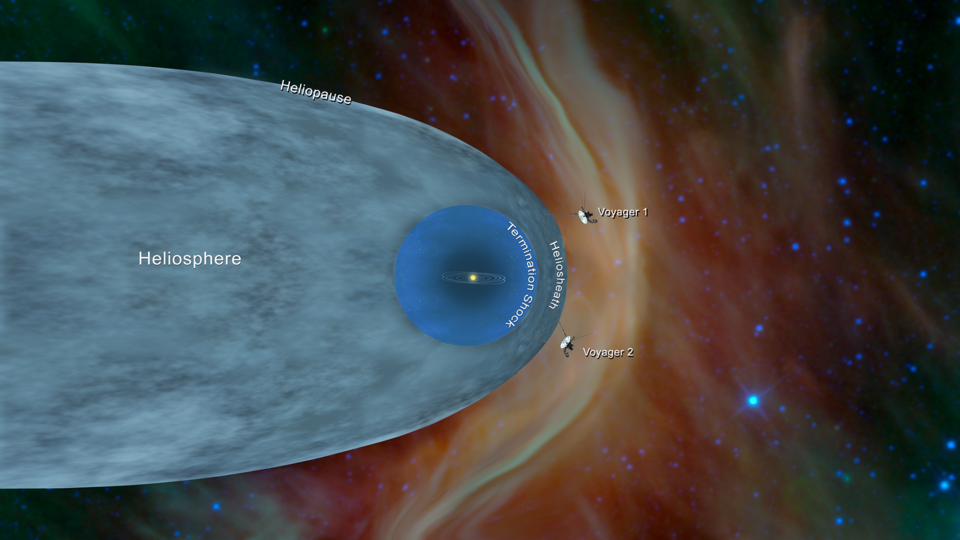
"Voyager 1 completed the phase of passing thru the Termination Shock in December 2004 at a distance of 94 AU (about 9 Billion miles), while Voyager 2 completed it in August 2007 at a distance of 84 AU (about 8 Billion miles)." [25]
For an approximate distance comparison from the Sun ;
Jupiter is almost 500 Million miles out,
Saturn is almost 900 Million miles,
Uranus is about 1.8 Billion miles,
Neptune is about 2.9 Billion miles,
Pluto is about 3.5 Billion miles.
The Termination Shock is about 8 or 9 Billion miles out,
and the Heliopause is at 14 or 15 Billion miles away.
As Mainstream describes:
"After passing thru the Termination Shock and entering into the Heliosheath, the spacecraft were in an area that is dominated by the Sun's Magnetic Field and Solar Wind particles. After passing through the Heliosheath and its outer boundary layer called the Heliopause, the two Voyagers began their first phase of Interstellar exploration. This is the region where the Sun's influence rapidly decreases and Interstellar Space can now be detected." [1]
As the ISM is what is beyond our Sun's Heliopause, and this is where the Galactic Electron Drift is 'flowing past us' at about a theorized 50 meters per second, and in the Electric Theory of the Universe, our Sun is a 'positive anode' in the 'Galactic Electric Circuit', and the electrons are a 'negative cathode' in the 'circuit'. This negative charge 'electron drift' is attracted to our Sun's 'positive' charge Anode. And so, many, if not most, of these 'drifting past' electrons are now 'drawn' to moving toward the Sun. This is Where our Sun gets its Energy, that it then radiates out as sunlight and other wavelengths of the EM Spectrum. Personally I'm not certain how long it takes an electron to get to the Sun from the Heliopause, but it, and they, eventually do, and when they do, they are 'ingested' by the Sun. This is why the Sun's Photosphere, where the overwhelming majority of visible light wavelengths are produced, is so powerfully bright in the visible light spectrum; because the incoming electrons are making the Arc Mode of 'transmission' in their arrival due to their amassed concentrations and collision energy with the Sun's Photosphere's dense plasma matter atoms and molecules, whereas in the Sun's Corona they are in a Glow Mode of transmission due to its tenuous thinness, and on their journey from the Heliopause to the Sun they are in the Dark Mode of transmission due to the great rarefaction of outer space in general.
Electric Energy has 3 modes of transmission in its journey thru the Special State of Matter : The Dark Mode, the Glow Mode, and the Arc Mode.
[ What is termed the 'Solar Wind' by Mainstream is a very misleading and inaccurate term in several ways, but we will use it here for the expediency of a common-speak 'label' that we've all heard. And, rather than try and coin a more accurate term right now, I'll be working to come up with a better term to replace 'solar wind' later on. ]
The Solar Wind is in the Dark Mode of 'transmission', as we do not see any evidence of it with our eyes or our Earth based instruments.
The glowing parts of a Planetary Nebula, or our Sun's Corona, for example, are in the Glow Mode.
The Photosphere on our Sun is the Arc Mode, as this is like the electric arc that we see when someone is arc welding ! It is extremely bright and can damage our eyes very quickly, so we must not watch an arc welder at work, nor look directly at the Sun, at least not for long, or we'll get permanent eye damage !
But I digress, the ISM has 'energy' in it, in the form of 'electrons', and that energy is attracted to a star, as stars are a 'positive anode' in the 'circuit' and electrons are a 'negative cathode' in the 'circuit', and both are attracted to each other. This is How a star gets the energy it needs to 'shine' and Where it gets that energy from, the ISM.
The Solar Corona
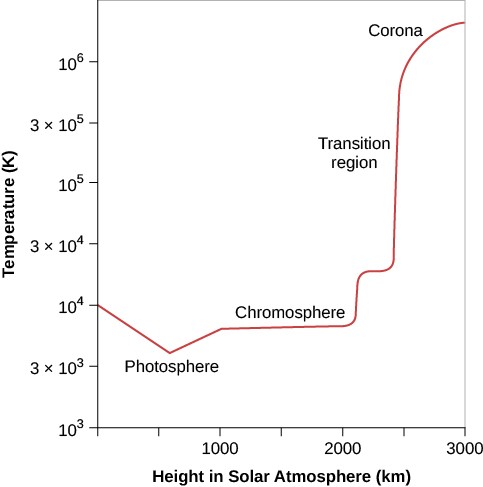
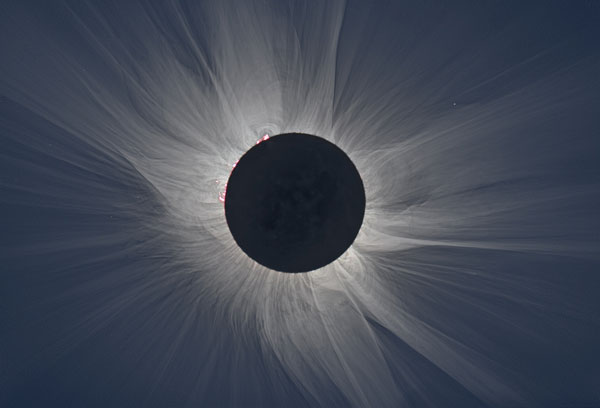
When ISM electrons arrive at our Sun, or a Star, they first encounter the solar Corona, the Sun's outermost atmosphere, which is characterized by its extremely high temperature, 1.5 to 2 Million Kelvins, and very low density. The Corona is visible as a glowing white halo during a Total Solar Eclipse, although normally its faint light cannot be seen without specialized instruments due to the overwhelming brightness of the Sun's surface Photosphere.

Spectroscopic studies of the Corona show that its visible light emission is a continuous background of all the visible wavelengths together with a few superimposed broad Emission Lines. Thus, its Spectrum is quite different from that of the Photosphere which has a visible light spectrum consisting of a continuous background with many dark Absorption Lines, as produced by some of the elements in the Sun. Early on, the Coronal Emission Lines did not have wavelengths that matched those identified from any known chemical element, and some astronomers suggested that they were produced by a new element, dubbed “Coronium”. In 1925, similar Emission Lines were observed in the spectrum of the Nova, RR Pectoris. In 1939, Walter Grotrian identified a Coronal Emission Line as being emitted by Iron with nine electrons removed, Fe9, and in 1942 Bengt Edlen identified a Coronal Line as being emitted from Iron with thirteen electrons removed, Fe13. It turned out that highly ionized atoms of familiar elements such as Iron, Calcium, and Argon are the source of several of the Coronal Emission Lines.
In spite of its high temperature, and because of its low density, the Corona is only about one-millionth as bright as the Photosphere in visible light wavelengths. In the early 1930s, a French scientist, Bernard Lyot, perfected the Coronagraph, a telescope that artificially creates an eclipse of the solar disk, this invention greatly enabled observations of the Corona, and has been vital for decades in monitoring and studying how it evolves with time, and in determining its temperature, density, and chemical composition.
A major advance in solar physics was the publication in 1958 of a classic paper on the Dynamics of Interplanetary Gas, by Eugene Parker at the University of Chicago. He deduced that, because of the high temperature and low density of the Corona, there should be a continual outflow of ionized gas, which he called the Solar Wind, and this from the Sun's outer edges. Confirmation of the existence of the Solar Wind was quickly forthcoming from early satellite experiments, and with it, the recognition that Earth is actually surrounded by this passing flow of charged particles. Earth is exposed to a constant flux of charged particles —mostly electrons, protons (hydrogen nuclei), and alpha particles (helium nuclei)— from the Sun, moving at speeds of a few hundred kilometers per second. However, only a tiny fraction of the Sun’s mass is lost via this solar wind, about 10^-14 of its mass per year, according to the Mainstream. This 'discovery' also proved Kristian Birkeland's theory that the Sun was the cause of the Northern Lights, and both Aurora Polaris events.
The white glow of the Corona, as seen during total solar eclipses, tends to be in long streamers, which extend from the limb (edge) of the Sun more or less radially, and when in loops are almost always associated with concentrations of surface magnetic fields. The nominal value of the Sun's radius is 700,000 kilometers, a length approximately equal to twice the distance from Earth to the Moon. Streamers viewed at eclipse are often found to extend outward 4 to 6 solar radii.
Studies of the Sun’s Corona have provided insights into observed features of other stars. In the late 1970s and early 1980s, X-ray observations from the High-Energy Astronomical Observatories (HEAOs) were interpreted to show, to the surprise of many investigators, that almost all types of stars have outer Coronas that radiate at the short wavelengths that are characteristic of high temperatures. It is now accepted that Coronas are a standard feature of stellar atmospheric structure.
The Corona has bright areas (hot), and dark areas called Coronal Holes (cold). Coronal Holes are relatively cool and thought to be areas where particles of the Solar Wind can escape from 'below'.
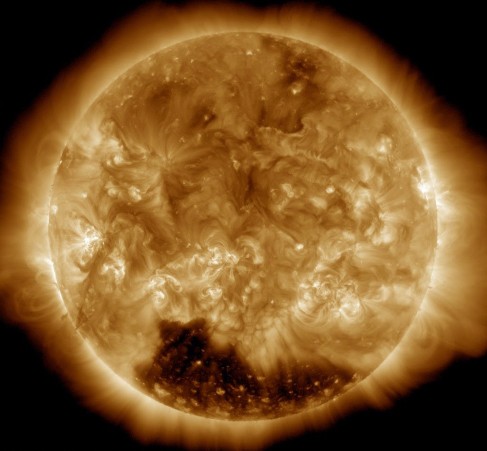
Coronal Hole: The dark area visible near the Sun’s south pole in this Solar Dynamics Observer spacecraft image, is a coronal hole.
In December 2021, NASA flew, for the first time, a spacecraft that entered the upper atmosphere of the Sun. This was the Parker Solar Probe. Launched in 2018, with an expected lifetime from 2021-2028, the mission is scheduled to make 24 orbits around the Sun. The probe is unique in that it is shielded by a carbon-composite shield that is 4.5 inches thick. Researchers hope Parker can provide insights into why the Sun’s Corona has a much greater temperature than its Photosphere. Parker may also compile new data on the nature of the Solar Wind. [10]
[ As the Standard Solar Model theorizes that a star is 'hottest' at its inner center core and progressively 'cools' as one moves further outward, and this 1 or 2 Million plus degree Corona conflicts with that Theory greatly, as the Photosphere is around 6,000 or so degrees. So why would the Corona be 2 or 3 Hundred Times Hotter than the Photosphere ? Albeit this is 'electron temperature' and not exactly 'thermal temperature', and there is a big difference between the two, but that is a subject for 'extra credit' and afterward the main discussion here now. ]
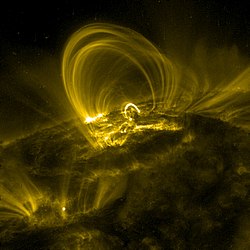
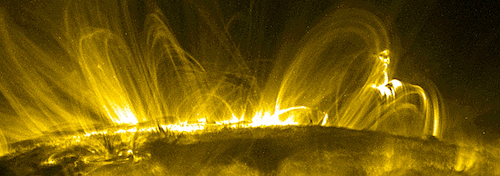
Coronal loops rooted in an active region. Imaged in 171Å by the TRACE satellite.
Chromosphere
The Chromosphere area extends above the Photosphere layer, to about 1,200 miles higher up, and lies below the Corona. The temperature rises from the Photosphere up across the Chromosphere to about 10,000 degrees Kelvin near its top. The Chromosphere is thought to be heated by convection from the underlying Photosphere in millions of tiny spikes called Spicules that rise approximately 3,000 miles above the Photosphere, but have a short duration of only a few minutes. This description is according to Mainstream.
The Solar Photosphere
The Photosphere is the lowest region of the Sun's atmosphere that we can normally see, it is estimated to be 180 to 240 miles deep, and is around 6,000 degrees Kelvin. It appears granulated and moving, which is the Anode Tufting action, with each granulation averaging about 600 miles wide. This is where the overwhelmingly major amount of visible light is generated and broadcast outward by stars. The Photosphere is very complicated and busy in its action, for this is where 'the rubber meets the road' so to speak, in terms of where the incoming galactic ISM energy is 'received' and then 'turned around' and rebroadcast outward by the star. So there's a heck-of-a-lot of activity going on here, and the very vigorous Anode Tufting action confirms this fact.
Granulation
These are convective patterns that occur in the Photosphere. Each granule is about 1000 km wide and consists of hot plasma rising in its center. As it releases its energy upward, the plasma cools and this makes it flow to the sides of the granule and sink back down into the Photosphere. Individual granules can persist for about 8 to 20 minutes, depending; after this, new ones, in slightly different places, develop. This is according to Mainstream.
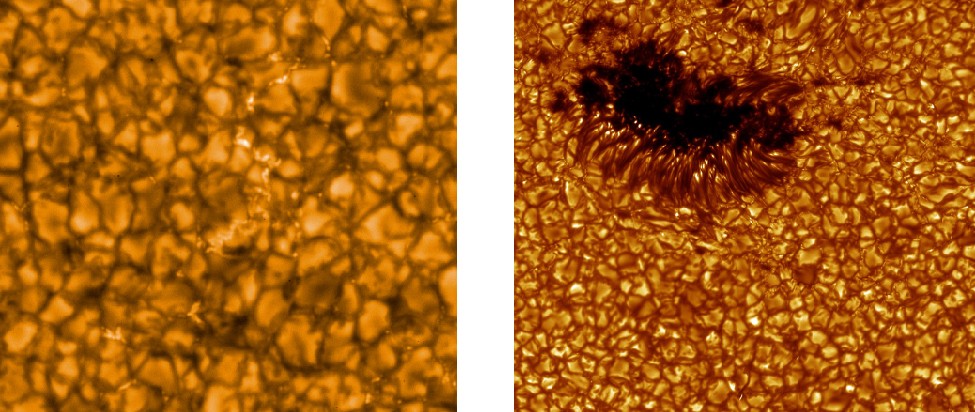
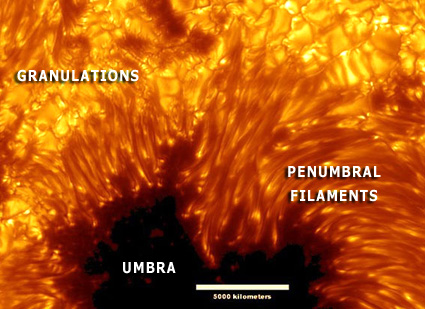
Granulation Pattern : The surface markings of the convection cells create a granulation pattern in this image (left) taken from the Japanese Hinode spacecraft. Hot plasma has a 'color', whereas the 'cooled' plasma has a 'dark' appearance and is at the perimeter edges of each 'granule'.
The right image shows an irregular-shaped Sunspot and granules on the Sun’s surface, seen with the Swedish Solar Telescope on August 22, 2003.
Anode Tufting
The Sun's "Red Chromosphere" is the counterpart to the glow above the Anode surface in a laboratory discharge tube. When the current density is too high for the Anode surface to accommodate, a bright Secondary Plasma forms within the Primary Plasma. This bright Secondary Plasma activity within the Primary Plasma, and its 'action' is termed 'Anode Tufting'. In the Sun's Photosphere, the Tufts are packed together shoulder-to-shoulder very tightly, so that their tops give the appearance of 'granulation', and as they are exceedingly stressed electrically, these 'Secondary Plasmas' glow very brightly, for they are in the 'Arc Mode' of electric energy transmission. These Anode Tufts also 'morph' and 'change', and visual photo film recordings of them show their 'activity', which in about 8 minutes they make a complete 'exhaustion' as a part of their 'life cycle', and are then 'reborn again' as new Tufts replace them.
Stars receive their power from outside, not inside. Any 'nuclear reactions' taking place are in the atmosphere of the Sun or in the Corona, and not in its core. The Solar Wind is an electric current connecting the Sun with its family of planets and with its Galactic boundary Electric Double Layer at the Heliopause, so the 85-year-old theory of nuclear fusion firing the solar furnace in its core, needs to be reexamined, and then removed from the literature.
Ralph Juergens showed that the Sun's Photosphere can be compared to the "tufted anode glow" in an electric discharge tube in the laboratory. The "Tuft" forms in the Sun's Photosphere because the deeper body of the Sun, as it is immersed in the extremely thin interplanetary plasma of its Solar System, which at its innermost boundary is the weakly luminous outer solar region called the Corona, cannot maintain an electrical discharge of much volume nor a continuous and contiguous 'active electrical connection' into the surrounding electrified galactic space beyond the very distant Sun's Heliopause and its Electric Double Layer, that of the ISM, in order to supply the highly positive Anode of its many-multiply ionized Iron "inner-core body" that is desperately seeking electrons in order to return to its "Ground State", which is its preferred electrical status. The "Solar Wind" is the Sun's attempt to make a 'conduit connection' using matter in the very electrically conductive state of 'plasma' so that the highly ionized Iron of its inner 'central-core body' can receive the 'electron drift' from the ISM, but !!! the Anode Tufting in its Photosphere does it a major 'disservice' in that as it 'receives' this 'electron energy' it then goes into the Arc Mode of transmission, and proceeds to 'radiate away' almost all of the Energy it receives !!! How's that for " Iron'y " .
Juergens noted that the problem could arise from any one or more of the following conditions :
(1) the solar body forms too small a surface to conduct the current required for the discharge,
(2) the surrounding plasma is too "cool", and / or
(3) the cathode drop is too large.
The "anode tuft" detached from, and now hovering above the "surface" of the underlying solar body, increases the effective surface area over which the Sun can collect electrons into its 'body', due to its 'roiling / boiling' action. Within the "tuft", volatile material - vaporized from the Sun - increases the gas density and contributes large numbers of extra electrons, because now, many of the frequent energetic collisions between the gas atoms will result in further ionization of the constituents, and thus providing even more electrons for 'energy transmission', as well as the resulting collateral action of the 'broad spectrum' of EM Spectrum energy emissions that are outwardly radiating and throwing off vast amounts of 'energy', and for which stars are so famous. [11]
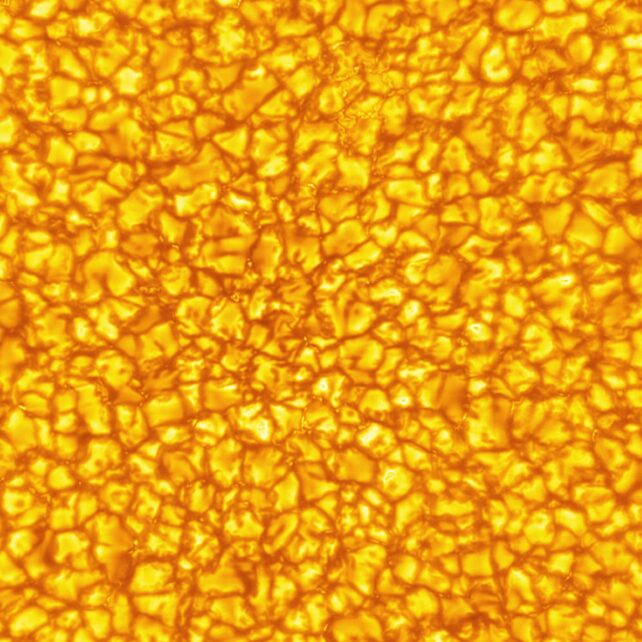
The Anode Tufts create a pattern of irregular shapes in the uppermost layer of the Sun’s Photosphere surface.
[ As a Side Note :
* The Fahrenheit temperature scale (F) when at 0F, is the freezing point of the salty oceans on Earth, as per wooden ships in centuries past to know when the Ocean was going to Freeze.
* The Centigrade temperature scale (C) likewise starts, but at where pure water freezes. 0C = + 32F. (minus -18C is where salt water freezes, at 0F)
* The Kelvin temperature scale (K) starts at 'absolute zero'. 0K = (minus) - 463F, or (minus) -273C.
Centigrade and Kelvin have the 'same size' degrees, but Fahrenheit has a 'smaller size' degree. 8 F degrees = 5 C or K degrees.
So happy calculating !! ( ain't it just like an 'exclusive industry' to make understanding their 'special language' as difficult as possible. What is wrong with these people ! They must want to make their special bailiwick as 'exclusive as possible'. ? )
*And don't forget the Rankin temperature scale (R) ! , it uses Fahrenheit size degrees, but starts at 'absolute zero'.
** Now "electron temperature" is a measure of what it takes to make an electron 'depart' from its 'atom', and the temperature scales listed above measure "thermal temperature" which is a measure of the 'collision energy' that results when atoms 'bump into' each other, a kinetic energy if you will. Whereas electron temperature is a measure of the 'excited nature' of the electrons surrounding the nucleus of an atom, in an 'electric energy' sense. ]
Sunspots
Sunspots are often around 6,000 degrees Fahrenheit while the rest of the Photosphere is around 10,000 degrees Fahrenheit.
Sunspots look darker because the 'spots', the Umbra, are typically at a temperature of about 3800 K, whereas the bright regions that surround them are at about 5800 K. The temperature of the Umbra is roughly 3000–4500 K, in contrast to the surrounding material at about 6000 K, leaving sunspots clearly visible as dark spots. This is because the luminance of the Photosphere constituents at these temperatures varies greatly with temperature differentials. Isolated from the surrounding Photosphere, a single Sunspot would shine brighter than the full Moon, and with a crimson-orange color. [14]
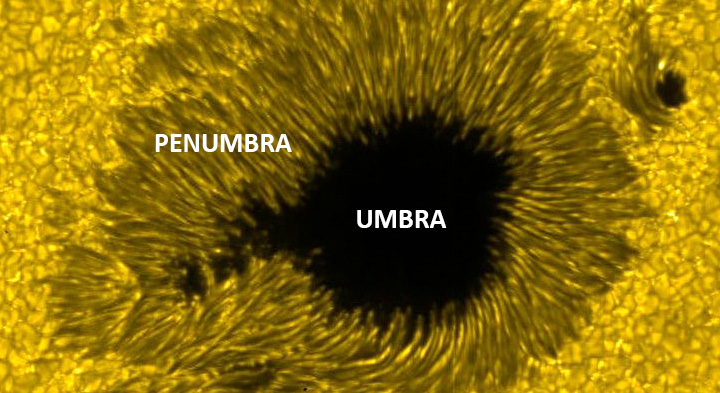
The spots are typically at a temperature of about 3800 K, whereas the bright regions that surround them are at about 5800 K
Sunspots appear within active regions, usually in pairs of opposite magnetic polarity. Their number varies according to the approximate 11-year Magnetic-Field-Reversal Cycle of the Sun.
Individual sunspots or groups of sunspots may last anywhere from a few days to a few months, but eventually decay. Sunspots expand and contract as they slowly move about on the surface of the Sun, with diameters ranging from 10 miles to 100,000 miles. [12] [13]
Indicating intense magnetic activity, sunspots accompany other active region phenomena such as Coronal Loops and Solar Prominences. Most Solar Flares and Coronal Mass Ejections (CME) originate in these magnetically active regions around visible sunspot groupings.
Sunspots have two main structures: a central Umbra and a surrounding Penumbra. The Umbra is the darkest region of a sunspot and is where the magnetic field is strongest and approximately vertical, or normal, to the Sun's surface or Photosphere. The Umbra may be surrounded completely or only partially by a brighter region known as the Penumbra. [14] The Penumbra is composed of radially elongated structures known as Penumbral Filaments and has a more 'angularly inclined' magnetic field than the Umbra. [15] Within sunspot groups, multiple Umbrae may be surrounded by a single, and continuous Penumbra. [16]
The Sun has an in-total twenty-two year cycle of magnetic activity. Eleven years for one Magnetic Reversal, and another eleven years to return to the previous magnetic orientation. Sunspots rise and fall in number with a period that is half of the total magnetic cycle, so concentrations of maximum magnetic flux have been observed to be in 1958, 1969, and 1980, for example. The total amount of material in the Corona is modulated by this cyclic variation of magnetic flux, and the total mass of the Corona varies by about a factor of 2 over the Sunspot Cycle. Also during the sunspot cycle, the number of Coronal Streamers occurring at any given maximum to minimum time varies by a factor of 2. Thus the Sunspot Cycle and its attendant Magnetic Field Reversal Event are 'connected' and so is activity in the Corona.
By observing sunspots and other solar features, it is possible to establish the rotation period of the Sun. Near the equator, it is found to be about twenty-seven days. The basic rotation rate of the Corona is approximately equal to the equatorial rotation rate, and the bright features that are used to follow Coronal rotation have lifetimes that range from one to five months. By the late 1930s, it was known that some effects of the Sun dominated Earth’s upper atmosphere. Ionospheric disturbances and perturbations of Earth’s magnetic field were observed to follow a twenty-seven-day period (similar to the Sun’s rotation). These so-called M-regions could not, however, be correlated with distinct solar structures, such as an enhanced concentration of magnetic field. Following the discovery of the Solar Wind and its variations in space and time, the problem of locating the solar origins for Earth-perturbing wind streams, like the Jet Stream, began to receive much attention from scientists. During the 1970s, the origins of these high-speed Solar Wind streams were eventually identified with open magnetic field configurations and solar Coronal Holes, based on the OSO 7 and ATM-Skylab data-sets. This correlation constituted a major breakthrough in the task of associating the interplanetary magnetic field and flux configuration at Earth, with the physical conditions of the Corona at the base of the Solar Wind origins.
Solar magnetic cycles last typically about eleven years, varying from just under 10 to just over 12 years, and we recently had a 14 year cycle. Over the solar cycle, sunspot populations increase quickly and then decrease more slowly. The point of highest sunspot activity during a cycle is known as Solar Maximum, and the point of lowest activity as Solar Minimum. This time period is also observed in most other solar activity and is linked to a variation in the solar magnetic field that changes polarity within this cycle period. [17]
Early in the cycle, sunspots appear at higher latitudes and then move towards the equator as the cycle approaches maximum, following Spörer's Law. Spots from two sequential cycles may co-exist for several years during the years nearest solar minimum. Spots from sequential cycles can be distinguished by the direction of their magnetic field and their latitude. [18]
The "Wolf Number Sunspot Index" counts the average number of sunspots and groups of sunspots during specific intervals. The 11-year solar cycles are numbered sequentially, starting with the observations made in the 1750s. [19]
George Ellery Hale first linked magnetic fields and sunspots in 1908. Hale suggested that the sunspot cycle period is 22 years, covering two periods of increased and decreased sunspot numbers, accompanied by magnetic field reversals of the solar magnetic dipole field. [20]
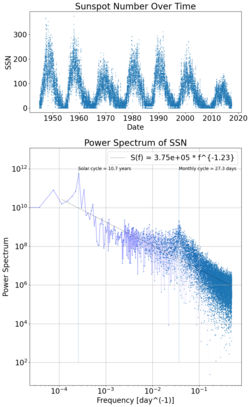
Power spectrum of sunspot numbers 1945 to 2017
Notice the year 2000 Maximum then had a 14 year duration before the next maximum was achieved, and that it was only about half as much ! similar to how the 1970 Maximum was considerably less than the 2 cycles before it, and that its duration was a bit longer than usual as well.

400-year history of sunspot numbers, showing Maunder and Dalton Minima, and the Modern Maximum.
- - End of Part 1 - -
References
[1] Starr, Michelle (19 October 2020). "Voyager Spacecraft Detect an Increase in The Density of Space Outside The Solar System". ScienceAlert. Archived from the original on 19 October 2020. Retrieved 19 October 2020.
[2] https://www.researchgate.net/profile/Michael-Mozina
[3] https://nobulart.com/the-iron-sun/
[10] https://www.ebsco.com/research-starters/astronomy-and-astrophysics/solar-corona
[11] https://www.kronos-press.com/juergens/k0801-electric-i.htm
[12] "How Are Magnetic Fields Related To Sunspots?". NASA. Retrieved 22 February 2013.
[13] "Sun". HowStuffWorks. 22 April 2009. Retrieved 22 February 2013.
Mossman, J. E. (1989). "1989QJRAS..30...59M Page 60". Quarterly Journal of the Royal Astronomical Society. 30: 59. Bibcode:1989QJRAS..30...59M. Retrieved 27 June 2021.
[14] Schlichenmaier, R.; Rezaei, R.; Bello González, N.; Waldmann, T. A. (March 2010). "The formation of a sunspot penumbra". Astronomy and Astrophysics. 512: L1. Bibcode:2010A&A...512L...1S. doi:10.1051/0004-6361/201014112.
Mathew, S. K.; Lagg, A.; Solanki, S. K.; Collados, M.; Borrero, J. M.; Berdyugina, S.; Krupp, N.; Woch, J.; Frutiger, C. (November 2003). "Three dimensional structure of a regular sunspot from the inversion of IR Stokes profiles". Astronomy & Astrophysics. 410 (2): 695–710. Bibcode:2003A&A...410..695M. doi:10.1051/0004-6361:20031282.
[15] Solanki, Sami K. (2003). "Sunspots: An Overview". The Astronomy and Astrophysics Review. 11 (2–3): 153–286. Bibcode:2003A&ARv..11..153S. doi:10.1007/s00159-003-0018-4.
[16] "Sunspots". NASA. 1 April 1998. Archived from the original on 3 April 2013. Retrieved 22 February 2013.
[17] Solanki, Sami K.; Krivova, Natalie A. (2006). "Solar variability of possible relevance for planetary climates". Astronomy & Astrophysics Review. 125 (1–4): 25–37. Bibcode:2006SSRv..125...25S. doi:10.1007/s11214-006-9044-7.
[18] Tribble, A. (2003). The Space Environment, Implications for Spacecraft Design. Princeton University Press. pp. 15–18.
Hale, G. E. (1908). "On the Probable Existence of a Magnetic Field in Sun-Spots". The Astrophysical Journal. 28: 315. Bibcode:1908ApJ....28..315H. doi:10.1086/141602.
[19] Babcock, Horace W. (1961). "The topology of the Sun's magnetic field and the 22-year cycle". The Astrophysical Journal. 133 (2): 572–587. Bibcode:1961ApJ...133..572B. doi:10.1086/147060.
[20] "Sunspot index graphics". Solar Influences Data Analysis Center. Retrieved 27 September 2007.
[25] "NASA - Voyager 2 Proves Solar System Is Squashed". www.nasa.gov. Archived from the original on 13 April 2020. Retrieved 6 February 2020.
Information provided herein by the Winnemucca Institute for Advanced Studies is for educational purposes. Our ‘Man on the Street Series’ of informative Science Papers is designed to provide a semi-technical answer to everyday experiences.