Human Wisdom – What Have We Forgotten ?
By Rev. Kat Carroll
March 26, 2026
In today’s society, human wisdom may sound like an oxymoron.
There was a time, back in ancient Greece, Egypt, Persia, China, and other regions, where knowledge and wisdom were studied, and people seemed more able to engage in deep thought and develop a connection to something beyond themselves. This connection was often sought for guidance—whether in problem solving, healing, or even during times of conflict and war.
The Greek words anthropos (human) and sophia (wisdom) point to a deeper understanding of what it means to be human. Rudolf Steiner later described Anthroposophy as a “path of knowledge”, a kind of spiritual science intended to lead what is spiritual in the human being to what is spiritual in the universe.
Anthroposophy can be seen as an echo of Hermetic principles attributed to Hermes Trismegistus, a figure who represents a blending of the Greek god Hermes and the Egyptian god Thoth. He is traditionally associated with foundational Hermetic texts such as the Corpus Hermeticum and the Emerald Tablet, believed to have emerged between the 1st and 3rd centuries.
https://ia601606.us.archive.org/25/items/pdfy-jcWLRBnyXg-DUcMH/The%20Corpus%20Hermeticum.pdf
https://www.ivantic.info/Ostale_knjiige/The%20Emerald%20Tablets%20of%20Thoth.pdf
Another system of thought, Theosophy, founded by Helena Blavatsky in 1875, is a mystical philosophy seeking universal Truth across religions through comparative study. It holds that divine knowledge can be directly experienced rather than simply studied.
It has been suggested in some sources that during his early years—around the age of thirteen—Jesus may have been initiated into the esoteric teachings of the Kabbalah or Qabalah. He would visit the temple and talk among the teachers. All who heard him were amazed at his understanding and his answers.
What becomes particularly striking, however, is how similar principles appear across entirely different cultures.
For example, parallels have been noted between Hermetic teachings and those found in the Tao Te Ching. Though separated by geography and tradition, both point toward a shared understanding of the relationship between humanity and a loving, universal force.
“Both traditions regard humanity as the living reflection of the Tao/God—a microcosm mirroring the macrocosm. We are siblings of the universe, embodying its totality. Thus, every cosmic principle finds resonance within us, affirming our role as co-creators.”
From – Hermeticism and Taoism
https://wayofhermes.com/hermeticism/hermeticism-and-taoism/
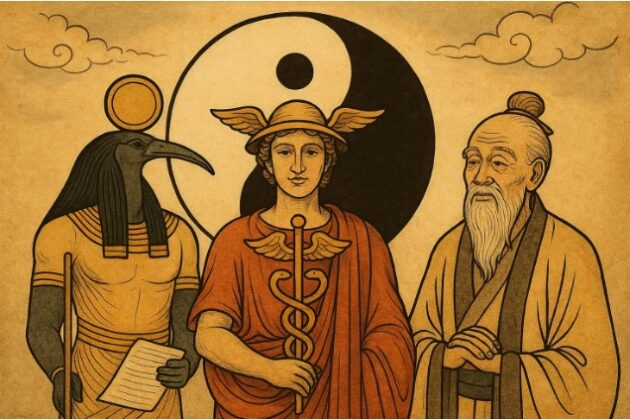
Though Hermeticism emerged in Egypt and the Middle East and Taoism in Asia, they converge on key principles—many of which are being revisited and embraced in our time, as individuals elevate their consciousness.
The concept of Gnosis, or direct spiritual knowing, is not new. It represents a path of reconnection between the individual and the divine, rooted in the idea that the universe itself is conscious or ordered by a greater intelligence. Throughout history, this knowledge has appeared, receded, and reemerged—sometimes preserved in mystery schools, sometimes rediscovered when conditions were right for its return.
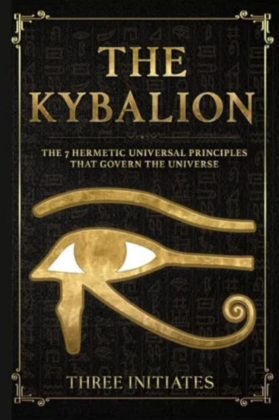
The Seven Hermetic Principles, outlined in the 1908 text The Kybalion, provide a framework often associated with this understanding:
Mentalism: “The All is Mind; the Universe is Mental.”
Correspondence: “As above, so below; as below, so above.”
Vibration: “Nothing rests; everything moves; everything vibrates.”
Polarity: Opposites are identical in nature but different in degree.
Rhythm: Everything flows out and in; all things rise and fall.
Cause and Effect: “Every cause has its effect; everything happens according to law.”
Gender: “Gender is in everything; everything has its masculine and feminine principles.”
Lofty Inspiration
Theosophy and Anthroposophy both invite us to look within—to connect with something greater than our limited perception. Ancient structures across the world guide our gaze upward.
Consider the obelisk, grounded on the Earth yet pointing toward the heavens—an echo of the Hermetic principle as above, so below, expressed visually rather than philosophically.
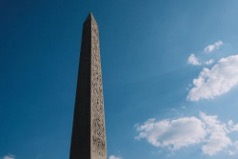
The obelisk is often associated with the Sun God Ra, representing a ray of sunlight frozen in stone, bridging the earthly and celestial realms. Its structure reflects balance, while its apex symbolizes ascent and connection.
Egypt’s Step Pyramid at Saqqara, considered to be one of the earliest pyramid structures.
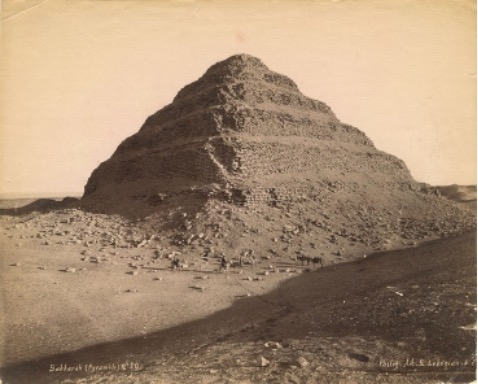
“A stairway to the sky is set up for me that I may ascend on it to the sky.” – The Pyramid Texts, Utterance 267.
And this idea does not end in Egypt.
From the pyramids of Mesoamerica to the stone circles of Europe, from the ancient pyramidal mounds of China and Mexico to cathedrals such as St. Patrick’s in New York—with their towering spires reaching skyward—we see the same pattern repeated across time and geography.

The Tao and Hermetic principles remind us that this reaching is not only toward the heavens, but inward as well—an invitation to rediscover the Source that lives both around us and within us.
These structures, built hundreds or thousands of years apart, share a common language.
They point upward.
They invite us to climb.
They create sacred spaces—places where we can pause, look to the stars, and feel connected to something vast, something eternal, something beyond words.
All of them, in their own way, invite us… to look up.
And yet today, our focus has shifted.
Closing Thoughts
In a fast-paced world of technology and materialism, many people spend more time looking down—at their phones, at the constant stream of information—than looking up, or within in quiet moments of contemplation.
We have access to more information than at any point in history—an abundance of knowledge. And yet, the loftiest Truths are among the most ancient, echoing from a time when humanity once understood its connection to a living, conscious universe.
Wisdom and Gnosis—the kind born of lived experience and inner knowing—may seem harder to find today… but they are are attainable, and perhaps simply waiting to be recalled.
Perhaps that is because not everything of value can be bought, downloaded, or explained.
Some knowledge must be discovered.
Experienced.
Felt.
For thousands of years, civilizations across the world have looked both inward and upward, seeking understanding not only in the heavens above, but within the quiet depths of human awareness. Perhaps that impulse has never truly left us. Perhaps it simply waits to be recognized again.
Is this the time to remember ? I believe it is.
For a Deeper Understanding:
What Is Anthroposophy ?
https://sydneyrudolfsteinercollege.com/articles/anthroposophy/
What is Theosophy ?
https://www.theosophical.org/about/theosophy
Jesus and the Seven Hermetic Principles
https://www.scribd.com/document/806343153/7hermeticjesus
The Kybalion: A Study of the Hermetic Philosophy of Ancient Egypt and Greece
https://en.wikipedia.org/wiki/The_Kybalion
Hermeticism, Daoism, TCM & the Taijitu – A shared language of patterns transcending time and geography !
https://www.eiihs.org/post/hermeticism-daoism-tcm-the-taijitu-a-shared-language-of-patterns-transcending-time-and-geograp
Hermetic Principals and Geometry
https://ma-vie-quantique.com/geometry/hermetic-principles-and-geometry/